

Large Gallbladder Stones: Causes, Risks and Laparoscopic Surgery
Reviewed by Dr. Sushant Wadhera, MBBS, MS (General Surgery), FNB (Minimal Access Surgery) | Delhi Medical Council Reg No. 42170 | Member, European Association for Endoscopic Surgery (EAES) | Last updated: September 2026
Case Summary
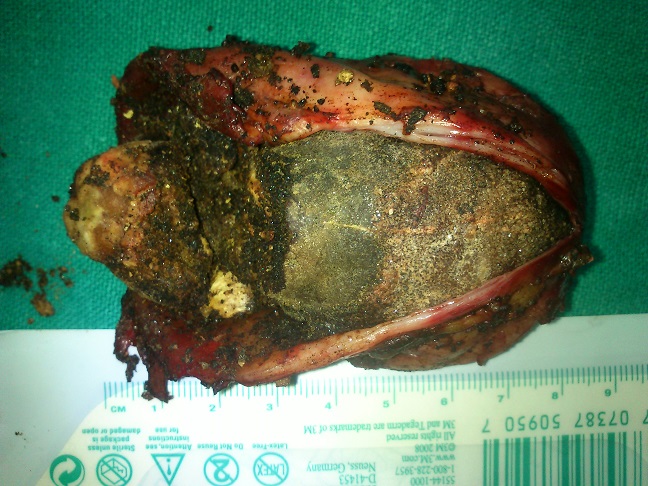
Dr. Sushant Wadhera’s clinic with symptoms suggestive of chronic gallstone disease. Pre-operative imaging revealed a single gallbladder stone measuring 9 centimetres (90 millimetres) — a large solitary gallbladder stone.
Despite the exceptional size of the stone and the technical challenges involved, the entire gallbladder was successfully removed laparoscopically — without conversion to open surgery.
For context: the average gallbladder measures about 7–10 cm in length. This single stone was as large as the entire organ, dramatically distorting its anatomy.
Why This Case Matters
Gallstones are common — affecting an estimated 10–15% of adults worldwide. Most gallstones are small (5–20 mm) and can be removed by standard laparoscopic gallbladder surgery without difficulty.
Stones larger than 3 cm are considered “giant gallstones” in medical literature and are associated with significantly higher surgical complexity. Stones larger than 5 cm are rare. A stone of 9 cm — nearly triple the giant-stone threshold — is exceptionally uncommon.
Successfully removing such a stone laparoscopically, without converting to open surgery, requires:
- Advanced laparoscopic technique
- Careful pre-operative planning based on imaging
- Meticulous dissection to avoid injury to the bile duct and liver
- Specialised instruments to extract the stone through small port incisions
- Experience with anatomically distorted gallbladders
How Do Gallbladder Stones Get This Large?
Large gallstones don’t form overnight. They usually develop over 10–20 years through a slow, gradual process. Several factors contribute to unusually large stone formation:
1. Long-Standing Untreated Gallstone Disease
Most large stones exist in patients who had smaller stones for many years but ignored symptoms or delayed surgery. Cholesterol and bile pigments continue to deposit, growing the stone incrementally.
2. Intermittent Symptoms
Interestingly, larger stones sometimes cause fewer symptoms than smaller ones because they are too big to move into the cystic duct and cause acute pain. Patients often live with vague discomfort for years, unaware of what’s growing inside.
3. High-Cholesterol Bile
Bile that’s supersaturated with cholesterol — often linked to diet, obesity, and metabolic factors — promotes stone growth over time.
4. Reduced Gallbladder Motility
When the gallbladder empties poorly (from prolonged fasting, rapid weight loss, or hormonal changes), bile stagnates and stones grow faster.
5. Age and Gender
Women aged 40+ are at higher risk of developing gallstones. Long-standing cases in this group can result in exceptionally large stones.
Why Large Gallstones Are Surgically Challenging
Compared to routine gallbladder surgery, removing very large stones presents several unique challenges:
Distorted Anatomy
A stone occupying nearly the entire gallbladder distorts the shape and position of surrounding structures — the cystic duct, cystic artery, and common bile duct at Calot’s triangle become harder to identify safely.
Thickened Gallbladder Wall
Long-standing large stones typically cause chronic inflammation, resulting in a thick, fibrotic gallbladder wall. This makes laparoscopic dissection technically demanding.
Adhesions to Surrounding Organs
The chronically inflamed gallbladder often adheres to the liver bed, duodenum, and colon. Careful dissection is required to separate these structures without injury.
Extraction Difficulty
Standard laparoscopic extraction bags are designed for smaller stones. A 9 cm stone often requires either extending one port incision slightly, or dividing the stone within the extraction bag before removal to minimise the incision.
Higher Risk of Bile Duct Injury
The most feared complication of gallbladder surgery — common bile duct injury — is significantly more common in complex cases. This is why very large stones should be handled by surgeons with advanced laparoscopic hepatobiliary experience.
Warning Signs You Should Not Ignore
If you have known gallstones, don’t wait until they grow to problematic sizes. Consult a surgeon promptly if you experience:
- Right upper abdominal pain, especially after fatty meals
- Pain radiating to the right shoulder or back
- Nausea, vomiting, or bloating
- Fever with abdominal pain (may indicate acute cholecystitis)
- Yellowing of skin or eyes (jaundice — may indicate a stone in the bile duct)
- Dark urine or pale stools
- Recurrent episodes of indigestion or food intolerance
Delayed treatment risks:
- Acute cholecystitis (severe gallbladder inflammation)
- Gallstone migration into the common bile duct (choledocholithiasis)
- Pancreatitis
- Gallbladder empyema (pus-filled gallbladder)
- Rarely, gallbladder cancer — long-standing large stones are a known risk factor
Recovery Timeline in This Case
| Time after surgery | Milestone |
| 2–4 hours | Awake, mobile with assistance, sips of clear liquids |
| 6–8 hours | Independent walking, light diet initiated |
| 24 hours | Discharged home, pain well-controlled with oral medication |
| Day 3–5 | Normal daily activities, driving short distances |
| Day 7–10 | Return to office/desk work |
| Week 3 | Full return to normal activity including exercise |
Despite the complexity of the case, recovery followed a standard laparoscopic gallbladder surgery timeline — a testament to the benefits of minimally invasive technique even in difficult cases.
Alternatives to Consider Early
For patients with early-stage gallstones (before they grow this large), several minimally invasive options are available:
- Standard 4-port laparoscopic cholecystectomy — the gold standard for routine cases
- Reduced-port laparoscopic surgery — 2–3 ports instead of 4, less scarring
- Single-incision (scarless) laparoscopic gallbladder surgery — no visible scar, best for cosmetically-conscious patients with early disease
Once stones grow very large or cause complications, single-incision and reduced-port options are usually not feasible — patients end up needing standard or complex laparoscopic surgery. This is why early treatment matters.
Frequently Asked Questions
How large can a gallbladder stone actually get?
Gallstones commonly range from a few millimetres to 2–3 cm. Stones larger than 3 cm are considered “giant”. Stones of 5 cm and above are rare, and stones of 9 cm — like this case — are exceptional. In medical literature, the largest reported gallstones have measured 15+ cm, but these are extraordinary outliers.
Do large gallstones cause more pain than small ones?
Not necessarily. Very large stones can actually cause fewer acute pain episodes because they’re too big to lodge in the cystic duct and cause biliary colic. Instead, patients often experience chronic low-grade discomfort, food intolerance, or vague digestive issues for years.
Can very large gallstones be removed without surgery?
No. Non-surgical options like oral bile acid therapy or shock-wave lithotripsy are largely ineffective for large stones and are not recommended. Laparoscopic gallbladder removal is the definitive treatment.
Is laparoscopic surgery possible for very large gallstones?
Yes — in experienced hands, even 9 cm stones can be removed laparoscopically, as this case demonstrates. However, the risk of conversion to open surgery is higher, and the case should be handled by a surgeon with advanced laparoscopic hepatobiliary experience.
How long is recovery after removal of a large gallstone?
When the surgery is completed laparoscopically, recovery is similar to standard gallbladder surgery — 24-hour hospital stay, return to normal activity within 1–2 weeks. If conversion to open surgery is required, hospital stay extends to 4–5 days and recovery to 4–6 weeks.
Can gallstones grow back after surgery?
No — once the gallbladder is removed, stones cannot form in the gallbladder because the organ no longer exists. In rare cases, stones may form in the bile duct after surgery, but this is uncommon and usually related to specific risk factors.
Are large gallstones linked to gallbladder cancer?
Long-standing gallstones, especially large ones (over 3 cm), are a recognised risk factor for gallbladder cancer, although the absolute risk remains low. This is one important reason not to ignore known gallstones for years.
How do I book a consultation with Dr. Sushant Wadhera for gallbladder concerns?
You can book an appointment online or call +91-7011165994. Consultations are available across multiple hospitals in Delhi NCR.
Key Takeaways
- Gallstones can grow to exceptional sizes if ignored — this case had a 9 cm stone
- Even very large stones can be removed laparoscopically in experienced hands
- Larger stones don’t always cause more pain — some patients live with them for years unknowingly
- Long-standing large stones carry higher surgical complexity and higher cancer risk
- Early treatment of small gallstones is far easier and safer than delayed surgery on giant stones
If you have been diagnosed with gallstones — even small ones — consult a qualified laparoscopic surgeon early. What starts as a small stone can grow into a complex surgical case over years.
