
Laparoscopic Sleeve Gastrectomy in Delhi
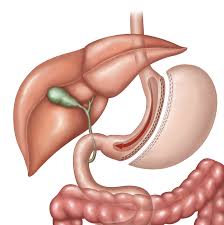
Laparoscopic sleeve gastrectomy is a weight-loss surgery in which roughly 75–80% of the stomach is removed, leaving a narrow tube or “sleeve.” It is performed through small keyhole incisions, takes about 60–90 minutes, and most patients go home within 24 hours. In Delhi, Dr. Sushant Wadhera performs this procedure at Fortis C-DOC, PSRI, Apollo Spectra and other major hospitals across Delhi NCR.
How sleeve gastrectomy works
The procedure works in two ways at once.
The obvious one is restriction. A smaller stomach holds less food, so you feel full sooner and eat fewer calories. But restriction alone does not explain the results seen with this operation.
The part of the stomach that is removed — the fundus — produces most of the body’s ghrelin, the hormone that signals hunger. Removing it reduces hunger at a hormonal level, not just a mechanical one. Food also moves faster into the small intestine, triggering hormones that improve insulin sensitivity and blood sugar control.
This is why sleeve gastrectomy is now classified as a metabolic procedure and not simply a restrictive one. Many patients see improvement in type 2 diabetes within days of surgery — before any meaningful weight loss has occurred.
Who is a candidate
In India, bariatric surgery is generally considered when:
- BMI 37.5 or above, with or without other health conditions
- BMI 32.5 or above with at least one obesity-related condition — type 2 diabetes, hypertension, obstructive sleep apnoea, PCOS, fatty liver or joint disease
- Non-surgical weight-loss attempts (diet, exercise, medication) have not produced sustained results
These thresholds are lower than Western criteria because South Asians develop metabolic complications at lower BMIs.
Sleeve gastrectomy may be preferred over gastric bypass for patients who:
- Want a simpler operation with no rerouting of the intestine
- Have had previous abdominal surgery with significant adhesions
- Need to continue medications that require normal intestinal absorption
- Have inflammatory bowel disease
It may not be the right choice for patients with severe, long-standing acid reflux or a large hiatus hernia, as the procedure can worsen reflux. In those cases, a gastric bypass is usually the better option. This is assessed during consultation, often with an endoscopy.
What to expect — before surgery
Work-up typically takes 1–2 weeks and includes blood tests, an ultrasound, an upper GI endoscopy, and a cardiac and anaesthetic assessment. You will also meet a dietitian, who will start you on a pre-operative liquid diet for roughly two weeks.
That liquid diet is not optional. It shrinks the liver, which sits directly over the stomach, and makes the operation significantly safer and technically easier.
The procedure
Sleeve gastrectomy is performed laparoscopically under general anaesthesia through four to five incisions, each under a centimetre. The stomach is divided vertically using a surgical stapler, the larger outer portion is removed, and the staple line is reinforced.
Operating time is usually 60–90 minutes. There is no cutting or bypassing of the intestine, and nothing is left inside the body — no band, no implant.
In selected patients, a reduced-port or single-incision approach may be possible, leaving fewer visible scars.
Recovery timeline
| Period | What happens |
|---|---|
| Day of surgery | You are walking within a few hours. Sips of water are usually started the same evening. |
| Day 1–2 | Discharge for most patients. Clear liquids only. |
| Week 1–2 | Full liquid diet. Light walking encouraged. Desk work is often possible from week 2. |
| Week 3–4 | Pureed and soft foods introduced in stages under dietitian guidance. |
| Week 5–6 | Gradual return to solid food. Normal activity and exercise resumed. |
| Month 3–12 | Most of the weight loss occurs in this window. Follow-up visits and blood tests continue. |
Expected results
Most patients lose 60–70% of their excess body weight within 12 to 18 months. The steepest loss happens in the first six months.
Beyond the weight itself, published outcomes and clinical experience show meaningful improvement in type 2 diabetes, blood pressure, sleep apnoea, cholesterol, fatty liver and PCOS-related infertility for a majority of patients.
An honest caveat: surgery reduces hunger and restricts intake, but it does not override behaviour indefinitely. Patients who return to high-calorie liquid calories — soft drinks, sweetened tea, alcohol — can regain weight. Long-term results depend on follow-up and habit change.
Risks and complications
Sleeve gastrectomy is a safe operation in experienced hands, but it is still major surgery and the risks should be understood.
- Staple line leak — the most serious complication, occurring in roughly 1% of cases. Managed with drainage, antibiotics and occasionally endoscopic intervention.
- Bleeding — uncommon, usually managed conservatively
- Acid reflux — new or worsened reflux develops in a minority of patients; usually controlled with medication
- Stricture — narrowing of the sleeve, treatable endoscopically
- Nutritional deficiency — vitamin B12, iron and vitamin D require lifelong supplementation and monitoring
- Gallstones — rapid weight loss increases the risk
Sleeve gastrectomy is not reversible. The removed portion of the stomach cannot be restored.
Why Dr. Sushant Wadhera
Dr. Sushant Wadhera is a bariatric and laparoscopic surgeon practising in Sarita Vihar, South Delhi, with over 21 years of surgical experience. He holds an MBBS, an MS in General Surgery, and an FNB in Minimal Access Surgery from Sir Ganga Ram Hospital, and is a member of the European Association for Endoscopic Surgery (EAES). He is registered with the Delhi Medical Council (Reg. No. 42170).
He performs sleeve gastrectomy at Fortis C-DOC, PSRI Hospital, Apollo Spectra & Cradle Royale (Nehru Place), Yashoda Hospital (Kaushambi) and Kailash Hospital (Noida).
FAQs
Is sleeve gastrectomy reversible? No. A portion of the stomach is permanently removed. If further weight loss is needed later, the sleeve can be converted to a gastric bypass, but the original stomach cannot be restored.
How much weight will I lose? Most patients lose 60–70% of their excess weight over 12–18 months. Individual results vary with starting BMI, age, diet and activity.
Will I need vitamins for life? Yes. Vitamin B12, iron, calcium and vitamin D supplementation is lifelong, with blood tests at regular intervals.
How long before I can return to work? Desk-based work is usually possible after 2 weeks. Physically demanding work takes 4–6 weeks.
Does sleeve gastrectomy cure diabetes? It leads to significant improvement or remission of type 2 diabetes in a majority of patients, often within days. “Cure” is not the right word — remission can be lost if weight is regained.
Sleeve or bypass — which is better? Neither is universally better. Sleeve is simpler with fewer nutritional issues; bypass gives better results for severe reflux and long-standing diabetes. The choice depends on your specific case.
Will I have visible scars? Four to five scars under a centimetre each, which fade considerably over 6–12 months. Reduced-port techniques may be possible in selected patients.
Can I get pregnant after sleeve gastrectomy? Yes, and fertility often improves. Pregnancy is generally advised to be deferred for 12–18 months until weight stabilises.
