

Rectal Prolapse Treatment in Delhi
Rectal prolapse occurs when part or all of the rectum slips from its normal position and protrudes through the anus. Patients may notice a lump coming out during bowel movements, difficulty controlling stools, mucus discharge, constipation or a feeling of incomplete evacuation.
In adults, rectal prolapse generally does not resolve permanently on its own. Treatment is planned according to the type and severity of prolapse, bowel symptoms, age, previous surgery and overall health. Surgical options may include abdominal rectopexy or perineal procedures depending on individual clinical factors.
Rectal Prolapse is a condition where a part of the rectum comes out of the anus.
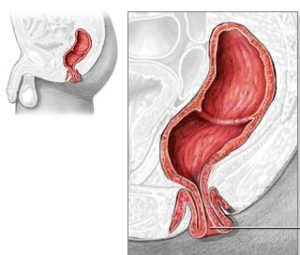 The rectum which is the last part of the large intestine loses the normal attachments that keep it fixed inside the body, allowing it to slide out through the anal opening, turning it “inside out.”
It is like a opening of a telescope.
What Is Rectal Prolapse?
The rectum is the final part of the large intestine. It is normally held in position by surrounding muscles, connective tissues and pelvic-floor structures.
Rectal prolapse develops when these supporting structures weaken, allowing the rectum to descend downward and, in some cases, protrude outside the anus.
The prolapse may be partial, involving only the inner lining of the rectum, or full-thickness, involving the entire rectal wall.
What are the causes of Rectal Prolapse
- Chronic Constipation and excessive straining is the most common factor.
- Also seen in Chronic Diarrhoea cases.
- Old age, with loss of strength in the attachments may also cause it.
It can be embarrassing and has a negative effect on a patient’s quality of life. Although not always required, the most effective treatment for rectal prolapse is surgery.
Chronic constipation and piles
What are the symptoms

- Mass or a lump coming out especially when passing motion or straining.
- Initially the mass may go back inside.
- In long standing cases , it has to pushed back inside manually.
- Rarely it may become stuck out side the anus in severe cases.
What are the Types
-
Incomplete/ Partial
-
Complete
Here the entire thickness and circumference of the rectum “telescopes” out of the anus.
Treatment
Surgery is the main stay of the treatment.
The mechanical loss of support to the rectum is restored.
Rectum is restored back to its normal position in the belly.
Types of Surgery
Incomplete / Partial Prolapse
- Trans Anal Approach using Staplers
- Laparoscopic Rectopexy with Mesh or Sutures
Complete Prolapse
This condition requires more extensive surgeries like resection rectopexy.
Read more about rectal prolapse
Clinical Overview – Educational Information
Dr. Sushant Wadhera provides evaluation and surgical treatment planning for patients with rectal prolapse and other ano-rectal conditions in Delhi.
Treatment is selected according to the type and severity of prolapse, bowel habits, constipation, continence symptoms, previous surgery, age and overall health, rather than using the same surgical approach for every patient.
Dr. Sushant Wadhera
MBBS, MS (General Surgery), FNB (Minimal Access Surgery)
Bariatric, Laparoscopic & General Surgeon
Frequently Asked Questions
1. What is rectal prolapse?
Rectal prolapse occurs when part or all of the rectum slips from its normal position and may protrude through the anus. It can cause a visible lump, mucus discharge, constipation or problems with bowel control.
2. What are the common symptoms of rectal prolapse?
Common symptoms include a lump coming out during bowel movements, mucus discharge, rectal bleeding, constipation, difficulty emptying the bowel, a feeling of incomplete evacuation and leakage of stool in some patients.
3. What causes rectal prolapse?
Rectal prolapse may be associated with chronic constipation, excessive straining, pelvic-floor weakness, previous pelvic surgery, childbirth, increasing age and certain neurological or bowel-function disorders.
4. Can rectal prolapse heal without surgery?
In adults, full-thickness rectal prolapse usually does not permanently correct itself. Conservative treatment may help constipation and bowel symptoms, but surgery is often required for definitive correction.
5. How is rectal prolapse diagnosed?
Diagnosis usually involves medical history and physical examination. Additional tests such as colonoscopy, defecography, MRI defecography or anorectal manometry may be advised in selected patients.
6. What is laparoscopic rectopexy?
Laparoscopic rectopexy is a minimally invasive procedure in which the prolapsed rectum is returned to its normal position and secured within the pelvis using sutures or another appropriate fixation technique.
7. What is a perineal procedure for rectal prolapse?
Perineal procedures are performed through the anus rather than through the abdomen. Procedures such as Delorme or Altemeier surgery may be considered depending on the type of prolapse, age and overall health.
8. Which surgery is best for rectal prolapse?
There is no single procedure that is best for every patient. The choice depends on the type and length of prolapse, constipation, bowel-control problems, age, previous surgery and overall surgical fitness.
9. Can rectal prolapse come back after surgery?
Yes. Recurrence is possible after any rectal prolapse procedure. The risk depends on the type of surgery, prolapse severity, pelvic-floor function and individual patient factors.
10. Can rectal prolapse affect bowel control?
Yes. Some patients with rectal prolapse develop difficulty controlling gas or stool. Bowel control may improve after treatment in some patients, while others may continue to need additional management.
11. How long does recovery take after rectal prolapse surgery?
Recovery depends on the procedure performed and the patient’s health. Patients may need several weeks to gradually return to normal activities, while bowel function may continue to adjust over a longer period.
12. What should I avoid after rectal prolapse surgery?
Patients are generally advised to avoid excessive straining and heavy lifting during early recovery. Maintaining soft stools, adequate hydration and following the surgeon’s bowel-care instructions are also important.
13. When is rectal prolapse an emergency?
Urgent medical attention is required if the prolapsed rectum becomes stuck outside the anus, cannot be pushed back, becomes very painful or dark in colour, or is associated with heavy bleeding or bowel obstruction symptoms.
14. Is rectal prolapse the same as piles?
No. Piles are enlarged hemorrhoidal tissues, while rectal prolapse involves the rectum itself slipping downward. Both can cause a lump near the anus, so proper examination is important.
15. Who should I consult for rectal prolapse treatment in Delhi?
Patients with a persistent anal lump, prolapse during bowel movements, constipation or bowel-control problems can consult a surgeon experienced in colorectal and ano-rectal conditions. Dr. Sushant Wadhera provides evaluation and treatment planning for rectal prolapse in Delhi.
MBBS (Manipal 2004), MS General Surgery (DAVV Indore 2008), FNB Minimal Access Surgery (NBE)
Fellowship Sir Ganga Ram Hospital, New Delhi | Member EAES
Registration: Delhi Medical Council Reg. No. 42170 | Status: Active | Practicing Since: 2004
Affiliations (for information only): Fortis C-DOC Hospital, Chirag Enclave | PSRI Hospital, Sheikh Sarai | MASSH Hospital | SCI Hospital, Delhi
Clinic: C-379, Ground Floor, Pocket C, Sarita Vihar, New Delhi - 110076
Hours: Mon-Sat 9AM-9PM, Sun Closed | Phone/WhatsApp: +91-7011165994 | Email: sushantwadhera@gmail.com
